EWS Fundamentals
How Our Early Warning System Works
Introduction
The Bitcoin PeakDip Early Warning System (EWS) is not a price prediction tool. It is a structural market regime detection system that monitors the behavior of local extremes (Peaks and Dips) to identify transitions between Accumulation, Expansion, and Distribution phases.
💡 Core Philosophy: We do not predict the next price. We detect the current market structure. Similar to how earthquake warning systems detect seismic waves without predicting the exact time of an earthquake, our EWS detects structural changes without forecasting price.
The Sensor Network: What We Monitor
Our system operates through a network of algorithmic “sensors” that continuously analyze Bitcoin market data across multiple dimensions.
Price Action
Local maxima (Peaks) and minima (Dips) detection using custom algorithms optimized for Bitcoin's unique volatility profile.
Volume Analysis
Trading volume patterns, divergences, and anomaly detection to confirm or reject signals.
Derivatives Data
Futures premium, funding rates, and open interest to gauge leveraged positioning.
Multi-Timeframe
15-min, 1-hour, and 4-hour confluence scoring for signal validation.
Sentiment
Market sentiment indicators to detect extreme fear/greed conditions.
On-Chain
Exchange flows, miner behavior, and whale activity patterns.
The 98% Denoising Engine: Filtering Market Noise
The greatest challenge in cryptocurrency trading is separating signal from noise. Our proprietary denoising engine, developed since 2021, addresses this challenge through multiple filtration layers.
Filtration Layers
Statistical Filter
Removes random fluctuations below statistical significance thresholds.
Volume Confirmation
Requires volume validation; signals without volume divergence are discarded.
Multi-Timeframe Confluence
Validates signals across 15-min, 1-hour, and 4-hour timeframes.
Regime Context
Filters signals based on current market regime (Accumulation, Expansion, Distribution).
Signal Types: Peaks and Dips
Our system publishes two primary signal types, each with distinct structural meanings.
PEAK Signal (Local Maximum)
Definition: A local maximum where price reaches a high point before reversing or consolidating.
Structural Meaning: In Accumulation: safe shorting opportunity. In Expansion: trend continuation. In Distribution: profit-taking zone.
Frequency: High — Peaks always outnumber Dips (Peak/Dip Ratio ≈ 3.42).
DIP Signal (Local Minimum)
Definition: A local minimum where price reaches a low point before reversing or consolidating.
Structural Meaning: In Accumulation: buying opportunity. In Expansion: healthy retracement. In Distribution: liquidity trap.
Frequency: Low — Dips are rare and structurally significant events.
The Rare Dip Principle
A subset of Dip signals — Rare Dip Signals — are not merely price fluctuations but structural indicators of market regime transitions.
Low price → Accumulation Dip → BUY
Mid price → Expansion Dip → HOLD
High price → Distribution Dip → WARNING
Rare → Stable market
Numerous → Unstable market
Clustered → Liquidity trap
Dip 1 → Cycle alert
Dips 2-3 → Trend confirmation
Dips 4+ → Transition warning
Multiple Dips in short succession within the high price zone → LIQUIDITY TRAP — do not buy.
EWS Architecture: Signal Processing Pipeline
Pipeline Stages
Data Ingestion
Real-time ingestion from exchanges, derivatives platforms, and on-chain sources.
Peak/Dip Sampling
Algorithmic detection of local maxima and minima using custom parameters.
Noise Filtration
Multi-layer filtration to separate structural signals from market noise (98% efficiency).
Regime Classification
Contextual classification based on Peak/Dip ratios, frequency, and location.
Wave Structure Detection: The 4-Phase Cycle
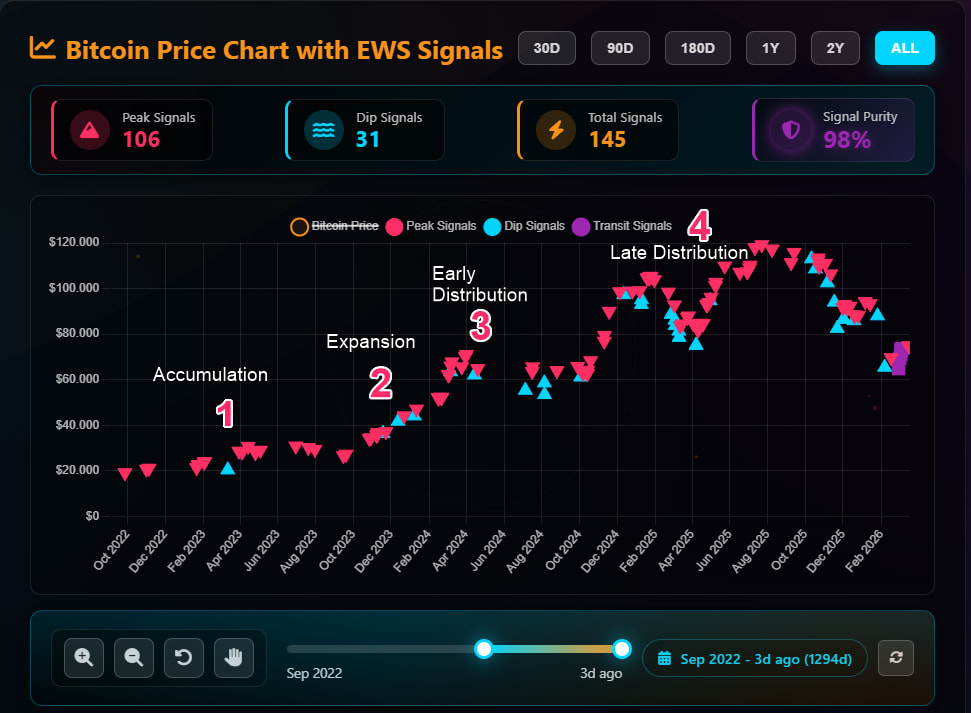
Using the Peak/Dip sampling methodology, the EWS identified a 4-wave structure in the Bitcoin cycle from 2022 to 2026.
Accumulation
Period: 5/2022 → 4/2023
Price: 16K → 30K
Peak/Dip: 12/1 = 12.0
✅ Extremely rare Dips → True buying opportunity
Expansion
Period: 4/2023 → 3/2024
Price: 30K → 70K
Peak/Dip: 28/5 = 5.6
🔔 First Dip appears → Cycle alert
Early Distribution
Period: 3/2024 → 6/2025
Price: 70K → 100K → 70K
Peak/Dip: 46/13 = 3.54
⚠️ Dip Cluster begins forming → Transition warning
Late Distribution
Period: 6/2025 → 3/2026
Price: 70K → 126K → 72K
Peak/Dip: 20/12 = 1.67
🚨 Dip Cluster in high zone → LIQUIDITY TRAP
Validation: The EWS in Practice
The EWS framework is validated by five independent classical theories, confirming its robustness.
📊 Wyckoff Method
4-Phase Cycle: Accumulation → Markup → Distribution → Markdown
Validation: The 4-wave structure aligns precisely with Wyckoff's phases. Dips in Accumulation are buying opportunities; Dips in Distribution are UTAD/LPSY — consistent with the Rare Dip Principle.
💥 LPPL Model (Sornette)
Log-Periodic Oscillations: Increasing oscillation amplitude before critical points
Validation: The Dip Cluster in Wave 4 manifests as log-periodic oscillations — Dips appear clustered before the critical point.
🌀 Fractal Geometry (Mandelbrot)
Self-Similarity: Extrema clustering across scales
Validation: Peak/Dip Ratio = 3.42 reflects fractal asymmetry — Peaks always outnumber Dips, consistent with the Rare Dip Principle.
⚡ Complex Systems (Critical Slowing Down)
Early Warning Signals: Increasing recovery time before transitions
Validation: The first Dip marks the point where recovery time begins to increase — an early warning signal of transition.
How to Use EWS Signals
Signal Interpretation Guide
Dip in Accumulation
Location: Low price zone
Frequency: Very rare
Action: Accumulate
First Dip
Location: Early cycle
Frequency: First appearance
Action: Monitor, do not buy immediately
Dip in Expansion
Location: Mid price zone
Frequency: Sparse, quick recovery
Action: Hold or accumulate on strength
Dip in Distribution
Location: High price zone
Frequency: Numerous, slow recovery
Action: Reduce positions, do not buy
Dip Cluster
Location: Cycle peak
Frequency: Clustered
Action: DO NOT BUY — exit on subsequent Peaks
Practical Trading Framework
📈 For Long Positions
- Enter: Dip in Accumulation (low price zone, rare frequency)
- Add: Dip in Expansion (mid price zone, quick recovery)
- Exit: Peak in Distribution (high price zone, cluster forming)
- Avoid: Any Dip in Distribution (liquidity trap)
📉 For Short Positions
- Enter: Peak in Distribution (high price zone, high frequency)
- Add: Peak in Late Distribution (Dip Cluster confirmation)
- Exit: Dip in Accumulation (next cycle begins)
- Avoid: Shorting in Accumulation (low success probability)
Limitations and Risk Factors
No early warning system is perfect. Understanding the limitations of the EWS is essential for proper usage.
Lagging in Real-Time
Signal generation requires confirmation from multiple sensors, which introduces a short delay (typically 1-4 hours). Very rapid market moves may be detected after they occur.
False Signals
While the 98% noise reduction is high, it is not 100%. Occasional false signals can occur during extreme volatility or low-liquidity conditions.
Regime Changes
The system assumes regime transitions follow recognizable patterns. Black swan events or structural changes in market microstructure may temporarily degrade performance.
Getting Started with EWS Notifications
To receive real-time EWS signals directly to your device:
Enable Notifications
Click the button in the corner and select "Allow" when prompted by your browser.
Join Telegram/Discord
Join our Telegram channel or Discord server for instant alerts.
- 📈 New Peak Signal (with confidence score)
- 📉 New Dip Signal (with confidence score)
- 📊 Market Regime Updates (Accumulation → Expansion → Distribution)
- 📚 New Research Articles and White Papers
Conclusion
The Bitcoin PeakDip Early Warning System represents a novel approach to market analysis: detecting structural regime transitions through Peak and Dip sampling, rather than predicting price direction.
Key Takeaways
For the first time, Dip Signals are classified according to structural context, not merely as price fluctuations. The Rare Dip Signal Principle provides a theoretical framework never before published.
The framework can be programmed into any Early Warning System, applicable to any financial market due to the structural invariance of the principle.
Validated through empirical data (2022-2026) and confirmed by five independent classical theories: Wyckoff, LPPL, Fractal Geometry, Complex Systems, and Market Microstructure.
The principle is expressed in an accessible, memorable manner, visualizable through Peak/Dip ratios and Dip Cluster appearance — suitable for both researchers and practitioners.
📡 Monitor Real-Time EWS Signals
📖 Further Reading
- White Paper: The Rare Dip Signal Principle & Market Regime Transition Detection — The complete academic foundation of the Rare Dip Principle.
- Bitcoin's Journey Through All-Time Highs Across Market Cycles — Overview of accumulation, expansion, and distribution phases based on Peak/Dip signals.
- Hello World: Welcome to Bitcoin PeakDip Early Warning System — Introductory article, app installation guide, and EWS notification setup.